
A Line Editor's Intro To GURPS
In the vein of A Line Editor's Intro To Fighting Fantasy, I'm here to talk about GURPS.
Who are you?
I'm Sean Punch. My background is in theoretical particle physics, but that was a long time ago. What's more important here (and to my job!) is that I've been a gamer since 1979 and a GURPS player since 1986.
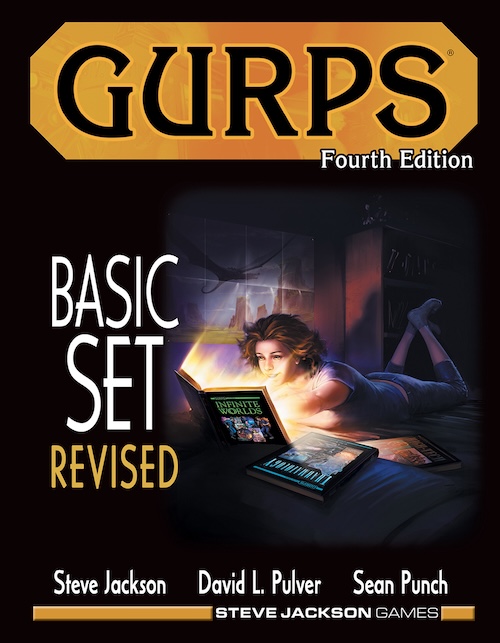
I joined Steve Jackson Games in 1995 (after a "trial run" in 1994), when I was engaged to maintain the consistency of rules, style, and voice for the sprawling GURPS line. In the ensuing 31 years, I've been directly involved with hundreds of publications, editing many of them and writing quite a few. Highlights include adapting the original GURPS Lite (1998), co-designing GURPS Fourth Edition (2004), creating the GURPS-based Dungeon Fantasy Roleplaying Game (2017), and overhauling the text of the GURPS Basic Set, Fourth Edition Revised (2026). In the gaps, I kicked off numerous long-running series within the line, most notably GURPS Action, GURPS Dungeon Fantasy, and GURPS Power-Ups.
What is GURPS?
The Generic Universal RolePlaying System – please forgive the camel case, it was the '80s – is a roleplaying game (I don't need to explain that to anyone reading the Daily Illuminator!) that aims to cover every fictional genre and setting (whence "generic") using a single, adaptable set of rules (whence "universal"). Designed by Steve Jackson, the First Edition was released in 1986. There have been three editions since.
GURPS boldly claims to be able to deliver "Anything You Can Imagine." The trick is that honoring this promise requires more pages than are found in the GURPS Basic Set. While that book is in some sense "the game" (as its title suggests), it would be more honest to point to the entire library of expansions and supplements, which number in the hundreds and represent the work of dozens of writers across four editions and 40 years. While you don't need all this stuff to play, it's a major part of the answer to "What is GURPS?"
Who's the target audience?
The easy answer would be "everybody who plays roleplaying games," since in principle, you can use GURPS to do anything that any other RPG does, and in the process save time, energy, and money by investing in just one game system. In practice, GURPS targets tinkerers and rules-hackers. That's because while supplements and subsystems might address specific genres and settings, covering every genre and setting would require an indeterminate quantity of content. At some point, it's more efficient to deliver general tools that let gamers create whatever they want . . . and tools are for craftspeople.
I won't lie: This appealed to me as a super-nerdy physics major back in 1986. While I truly believe that I've steered GURPS toward a bigger tent since 1995, and that it now accommodates narrative and casual gaming better than it used to (and requires less math!), it's still very much a toolkit for people willing to adapt it to their needs.
What makes GURPS awesome?
All complexity aside, GURPS consistently falls back on a few broad game mechanics. Once you learn these, you can understand the specialized subsystems in obscure supplements. If you don't want those, well, you can wing it using just the basics and not be too far from the "official" approach. Moreover, the game is rooted in reality – even if some genres and settings are anything but realistic! – so you can use real-world data (like the top speed of a car or the weight of a sack of gold coins) and your intuition instead of the rules, and also not go far astray. More basically, you can play it with just pencil, paper, and six-sided dice; you aren't stuck investing in a bunch of specialized components.
At the same time, the complexity is ultimately a merit, not a flaw. There really is a supplement covering nearly any topic you might find interesting. There really are rules for almost everything. You really can create anything you can imagine. And when the rules fall short . . . well, there's a very active fan community (on our forums and on Discord) that's only too happy to do rules-hacking for you.
What's a good way for someone new to GURPS to start?
Start with the latest version of GURPS Lite. This is a free 32-page summary. If you decide that it isn't for you, you'll be out nothing but the time it took you to read it.
If this leaves you feeling like GURPS is the game for you, the next step is to get the GURPS Basic Set, Fourth Edition Revised, which combines what were formerly two separate rulebooks into one, at a lower overall price. It also includes 27 pages of the most popular rules from the library, which means that you'll be able to put off buying supplements for a good long while. In fact, before buying anything else, get all the free stuff listed here.
Once you're comfortable with the game and know what kind of campaign you want to run, grab the specific supplements that suit your needs. The list on pp. 2-4 of Fourth Edition Revised is a big help, and you can view it in the preview of the book. Oh, and introduce yourself on the forums and the Discord, mentioned above, and ask for advice on the kinds of games you like and for help with any rules that stump you.
Anything else you'd like folks to know about GURPS?
Most important is the Barbecue Rule: GURPS is a massive beast, and you shouldn't try to eat the whole thing. Take only what you need. The rest will be there later if you need it. Nothing causes more headaches for new gamers than "rules overeating." You really, truly do not need to get it all now – and perhaps not ever. And consider who's telling you this: Someone who works for the company and has a vested interest in selling you its products!
Also be aware that GURPS is a genuine system, and much of the material assumes that you have certain prerequisite volumes. We publish free preview PDFs of all GURPS releases, and these always include the Introduction, which has "Required Books" and "Recommended Books" sections that spell out what these prerequisites are, even if the webpage for a given supplement fails to do so (though we strive to avoid such oversights). While there are a small number of self-contained resources that function as standalone games, these are rare and always labeled as such – don't buy, say, GURPS Fantasy expecting a self-contained fantasy game, because you'll need the Basic Set and probably many other volumes on fantasy races, fantasy technology, magic items, magic spells, monsters, and all the rest.
Finally, try to ignore whatever you've heard about the game being impossibly complicated. You do just about all of the math before the game starts, and most of that math is basic addition. Almost everything you do in play comes down to rolling 3d6 and adding them up. There have been complex design systems, but they're not most of the game and aren't required to play it, and most were for earlier editions . . . gamers have long memories. Of course, a game that sprawls as much as GURPS does will sometimes work better if you do some research, and that research might occasionally find a case where a writer in 2004 and a different writer in 2024 disagree, but the fandom and the designers (hi!) are accessible to help with that.
-- Sean Punch